
General news
NVIDIA RTX Innovations Are Powering the Next Era of Game Development
May
NVIDIA RTX ray tracing and AI-powered neural rendering technologies are redefining how games are made, enabling a new standard for visuals and performance. At GDC 2026, NVIDIA unveiled the latest path tracing innovations elevating visual fidelity, on-device AI models enabling players to interact with their favorite experiences in new ways, and enterprise solutions accelerating game development from the ground up. This post provides a detailed overview of these latest innovations, including: Introducing a new system for dense, path-traced foliage in NVIDIA RTX Mega Geometry Adding path-traced indirect lighting with ReSTIR PT in the NVIDIA RTX Dynamic Illumination SDK and RTX Hair (beta) for strand-based acceleration in the NVIDIA branch of UE5 Expanding language recognition support in NVIDIA ACE; production-quality on-device text-to-speech (TTS); a small language model (SML) with advanced agent capabilities for AI-powered game characters Enabling foveated game streaming for Apple Vision Pro with NVIDIA CloudXR 6.0 Accelerating in-game AI and streamlined shader compilation with new DirectX APIs Centralizing infrastructure and virtualized game studio workflows with NVIDIA RTX PRO 6000 Blackwell Server Edition Enabling scaling AI coding assistants with new NVIDIA Enterprise AI playbook Scaling game playtesting and player engagement globally with GeForce NOW Playtest
New system for path-traced foliage in NVIDIA RTX Mega Geometry
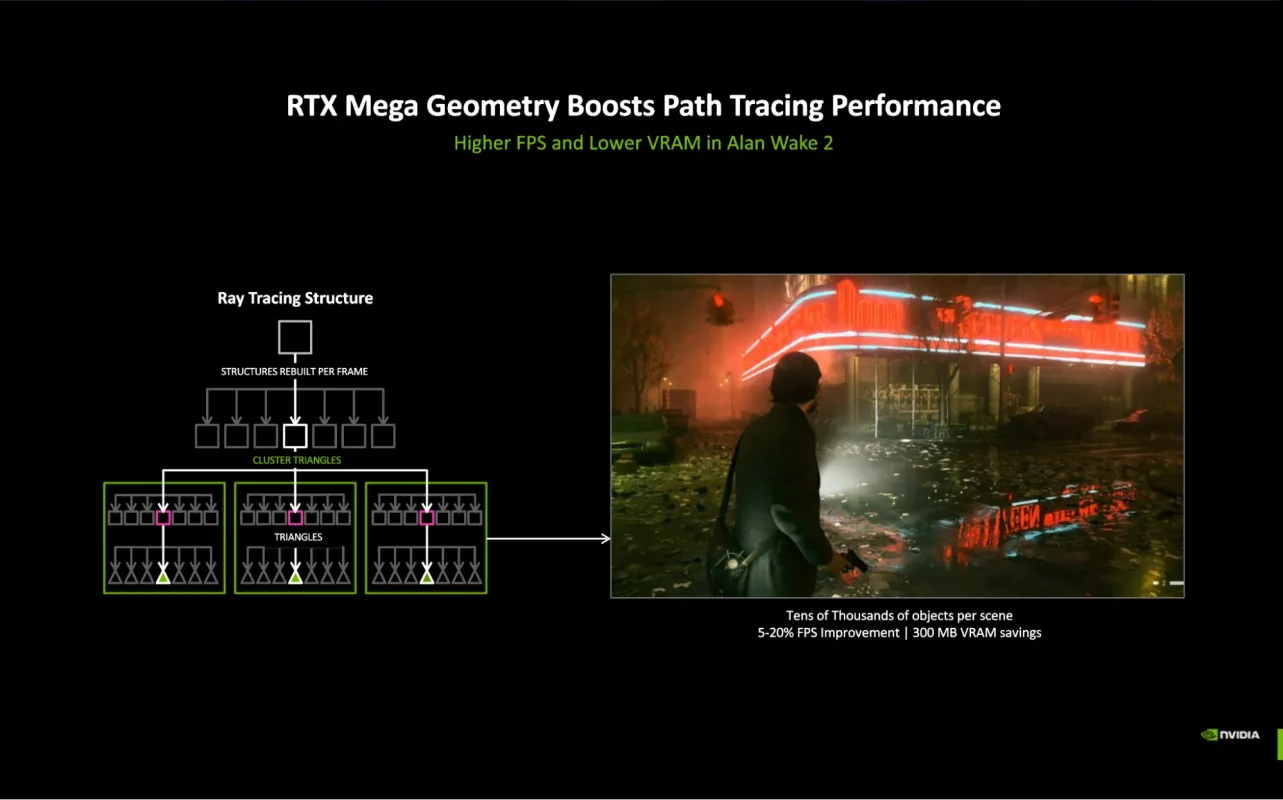
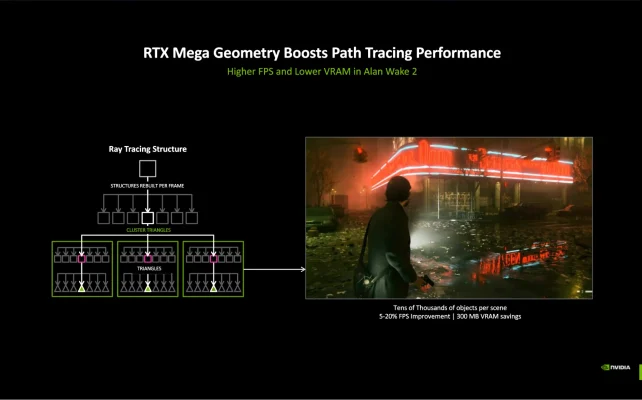
NVIDIA RTX Mega Geometry is a breakthrough technology that delivers unprecedented geometric detail to path‑traced worlds. Introduced last year, it compresses geometry into clusters and intelligently reuses them per frame as a world is traversed. Mega Geometry enables developers to build ray tracing structures 100x faster than previous methods, enabling full‑fidelity path tracing with advanced detail and real‑time tessellation. Remedy Entertainment applied RTX Mega Geometry to existing assets in Alan Wake 2, which saw a 5-20% boost in FPS and 300 MB VRAM reduction. Their upcoming title, CONTROL Resonant will also feature RTX Mega Geometry.
At GDC 2026, NVIDIA is offering a sneak peek into the new RTX Mega Geometry foliage system. Large natural environments such as forests remain a major challenge for real‑time ray tracing. These scenes pack countless complex, animated objects that heavily tax how quickly the GPU can build acceleration structures.
To tackle this challenge, NVIDIA is developing a new foliage system that uses partitioned top-level acceleration structures. This system instances and updates massive portions of a scene in every single frame. This advancement makes it possible, for the first time, to path trace dense environments featuring millions of detailed, uniquely animated foliage elements.
NVIDIA has partnered with CD PROJEKT RED to bring this new foliage technology to future titles. “Using the in-development RTX Mega Geometry foliage technology, we can bring fully path traced forests to the world of The Witcher,” said Cezary Bella, Rendering Engineer at CD PROJEKT RED. “We can’t wait for players to experience this level of detail in The Witcher 4.”
