
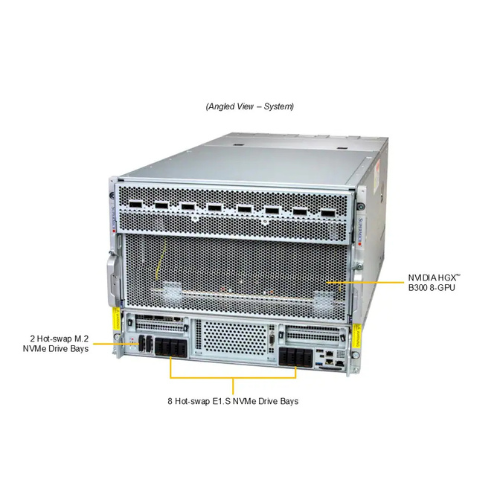
Server AI Supermicro AS-8126GS-NB3RT NVIDIA HGX 8-GPU B300
Contact
- CPU: AMD EPYC 9005/9004 Series.
- GPU: NVIDIA HGX 8-GPU B300.
- RAM: 24x DIMM slots 6400MT/s ECC DDR5 (Max 6TB).
- Hard Drive: 2x M.2 NVMe (boot drive), 8x E1.S Hot-swap NVMe.
- PCIe: 2x PCIe Gen 5.0 X16 FHHL Slots.
Overview of the Supermicro AS-8126GS-NB3RT AI Server
The AS-8126GS-NB3RT is an 8U rack server from Supermicro’s A+ Server series. This server is built on a dual-CPU AMD EPYC 9004/9005 platform, offering up to 384 cores and 768 threads. This is combined with the performance of an NVIDIA HGX 8-GPU B300 GPU cluster with a total of 2.3TB of HBM3e memory, along with 24 DDR5 RAM slots allowing for memory upgrades up to 6TB and flexible 800GbE network bandwidth combined with PCIe 5.0.
The power of the AS-8126GS-NB3RT helps businesses and data centers effectively handle massive workloads such as Generative AI, large-scale language model training, Deep Learning, and High-Performance Computing (HPC).
Key Advantages of the Supermicro AS-8126GS-NB3RT AI Server
High-Performance 2-Socket Configuration
The Supermicro AS-8126GS-NB3RT supports two of the most powerful AMD EPYC 9004/9005 CPUs currently available. If equipped with two AMD EPYC 9965 CPUs, this server can boast up to 384 cores and 768 threads to directly handle core- and thread-intensive tasks such as AI and deep learning workloads, high-performance computing (HPC), and virtualization.
Each CPU supports up to 12 RAM memory channels across a total of 24 DIMM slots. When all slots are filled, the maximum system capacity reaches 6TB, combined with the power of the EPYC 9005 Series, enabling transfer speeds of up to 6400 MT/s.
Flexible expandability with PCIe 5.0 interface
The Supermicro AS-8126GS-NB3RT offers easy upgrades to expand I/O connectivity. The server comes equipped with two PCIe 5.0 x16 FHHL slots by default. These high-bandwidth slots are ideal for installing additional high-speed network cards, DPUs, or high-performance storage expansion cards (RAID/HBA controllers).
Advanced E1.S NVMe Storage Drive Support
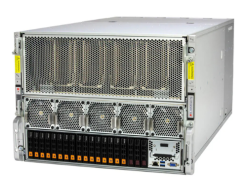
Instead of using the familiar 2.5-inch U.2 hard drive, the Supermicro AS-8126GS-NB3RT server is equipped with 8 E1.S standard drive bays on the front. The outstanding advantage of the E1.S standard is its slim design, which optimizes airflow, resulting in better heat dissipation and maintaining stable data transfer speeds even when the system is operating at high intensity.
Reviews
There are no reviews yet.